The Mathematical Theory of Communication by Shannon
The Mathematical Theory of Communication by Shannon
uuid: 20250221025506238373 title: The Mathematical Theory of Communication main-author: "Claude Shannon" tags: - "#book"
- "#unclassified"
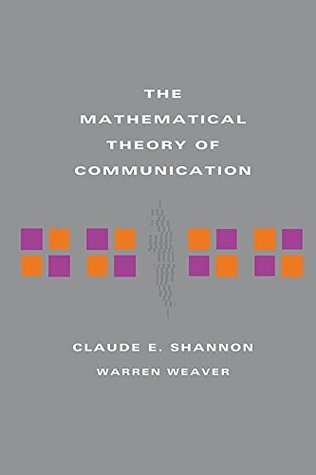 goodreads, wiki, amazon
openarchive, gutenberg
goodreads, wiki, amazon
openarchive, gutenberg
authors: - Claude Shannon - Warren Weaver
pdf links: - pdf_1 - pdf_2 - pdf_3 - pdf_4 - pdf_5 - pdf_6 - pdf_7 - pdf_8 - pdf_9
Short Description
"The Mathematical Theory of Communication" by Claude Shannon introduces the groundbreaking framework of information theory, detailing how information can be quantitatively measured, encoded, and transmitted over communication systems, laying the foundation for digital communication and data compression.
Goodreads Description
Scientific knowledge grows at a phenomenal pace--but few books have had as lasting an impact or played as important a role in our modern world as The Mathematical Theory of Communication, published originally as a paper on communication theory in the Bell System Technical Journal more than fifty years ago. Republished in book form shortly thereafter, it has since gone through four hardcover and sixteen paperback printings. It is a revolutionary work, astounding in its foresight and contemporaneity. The University of Illinois Press is pleased and honored to issue this commemorative reprinting of a classic.
AI Summary
Certainly! Here is a summary of "The Mathematical Theory of Communication" by Claude Shannon, including the key ideas and concepts presented in the book:
Summary of "The Mathematical Theory of Communication"
Introduction: - Claude Shannon's "The Mathematical Theory of Communication," originally published in 1948, is a foundational text in the field of information theory. - The work established the groundwork for digital communication, data compression, and reliable data transmission over noisy channels.
Key Concepts:
-
Information Theory:
- Shannon defined information quantitatively, introducing the concept of information entropy as a measure of uncertainty or information content.
- Information entropy quantifies the average amount of information produced by a stochastic source of data.
-
Entropy (H):
- The entropy ( H(X) ) of a random variable ( X ) is a measure of the amount of uncertainty in ( X ).
- Formula: ( H(X) = - \sum p(x) \log_2 p(x) ) where ( p(x) ) is the probability of outcome ( x ).
-
Redundancy:
- Redundancy refers to the amount of excess information or repeated patterns that can be reduced when transmitting data.
- It is the difference between the maximum possible entropy and the actual entropy.
-
Channel Capacity:
- The maximum rate at which information can be reliably transmitted over a communication channel.
- Depends on the channel's bandwidth and noise characteristics.
-
Noisy Channel Coding Theorem:
- States that it is possible to transmit information over a noisy channel at any rate lower than the channel capacity with an arbitrarily small error probability.
-
Source Coding:
- Also known as data compression, refers to reducing the number of bits required to represent data without losing information.
- Shannon's work laid the groundwork for techniques like Huffman coding.
-
Error Detection and Correction:
- Techniques to ensure reliable communication by detecting and correcting errors that occur during data transmission.
-
Bit and Symbol:
- Bit is the fundamental unit of information, representing a choice between two equally probable alternatives.
- Symbols refer to any set of states used to encode information.
Impact and Importance: - Shannon's work revolutionized telecommunications, computer science, and digital media. - His theories underpin modern technologies such as data compression algorithms, error-correcting codes, and cryptographic systems.
Applications: - Telecommunications: Improving the efficiency and reliability of data transmission. - Data Compression: Enabling efficient storage and transmission of data across networks. - Cryptography: Enhancing security by understanding the limits of data encryption.
Claude Shannon's work in "The Mathematical Theory of Communication" remains a cornerstone of modern digital communication and continues to influence fields like computer science, coding theory, and statistical learning.
Bertrand Russell Summary
Title: The Mathematical Theory of Communication by Claude Shannon
In the evolving landscape of science and thought where precision and clarity are of utmost importance, Claude Shannon's monumental work, The Mathematical Theory of Communication, emerges as a beacon of intellectual advancement in understanding the architecture of information. At the heart of this text lies Shannon's endeavor to formalize communication through mathematical rigor, akin to the way Euclid brought order to geometry.
Shannon's treatise begins with the ambitious task of conceptualizing the act of communication not as a mere exchange of words or ideas but as a sequence of indications transferred across systems. This process begins with an information source that generates a message, which is then conveyed to a transmitter. Here, the message is encoded into signals fit for a particular communication channel. The receiver, in its turn, must decode these signals to reconstruct the original message as it reaches its final destination, the information recipient.
Of seminal importance is Shannon's introduction of the concept of "entropy," a measure drawn from statistical mechanics, which quantifies the uncertainty or randomness inherent in a set of possible messages. Entropy, in this context, is illustrative of the maximum amount of information that can be transmitted by the channel, thereby providing a benchmark for the efficiency of communication systems—an intellectual bridge between abstract mathematics and the tangible immediacies of human interaction.
Indeed, Shannon's work is steeped in mathematical formality, yet it holds profound philosophical implications reminiscent of the interplay between knowledge and ignorance. By quantifying information in terms of probability and statistical patterns, he inadvertently touches upon age-old philosophical questions regarding the limits and structures of human knowledge.
The text also delves into the difficulties arising within communication systems, most notably the challenge of noise—random interference that distorts the signal. Through the ingenious application of redundancy, Shannon illustrates how systems might be designed to contend with such impairments, ensuring integrity and fidelity in message transmission.
Shannon's theorems lay the groundwork for what would become the field of information theory, providing the lexicon and symbols to articulate and resolve problems that were previously consigned to the intuitive and speculative. His methodologies underscore a simple yet profound aphorism: the universe, with all its complexity, can be counted and measured, provided the right framework is employed.
In summation, The Mathematical Theory of Communication transcends its technical maneuvers to become a philosophical discourse on the nature of information. Just as mathematics has often served to discipline and extend philosophy throughout history, Shannon's work offers both a rigorous and imaginative lens through which we might view and engage with the world—a testament to the power of analytical thought in the service of understanding and mastery over the phenomena that shape our reality.