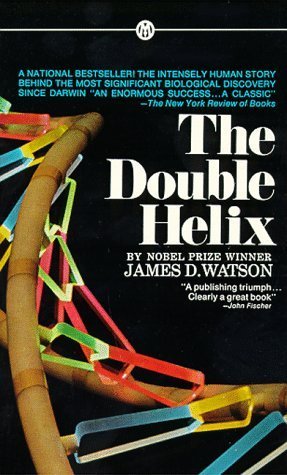
The Double Helix by James Watson
The Double Helix by James Watson
title: The Double Helix main-author: James D. Watson tags:
- #book
 goodreads, wiki, amazon
openarchive, gutenberg
authors:
- James D. Watson
pdf links:
- https://www.cshlpress.com/pdf/sample/AnnDblHelix.pdf
- https://media.hhmi.org/biointeractive/activities/doublehelix/IDG_DoubleHelix.pdf
- https://www.mskcc.org/teaser/1953-nature-papers-watson-crick-wilkins-franklin.pdf
- https://cdn.prod.website-files.com/66000f3d69736ba3db53cdfe/67216d4682cfd968a17ff537_kozusaxu.pdf
- https://dosequis.colorado.edu/Courses/MethodsLogic/papers/WatsonCrick1953.pdf
goodreads, wiki, amazon
openarchive, gutenberg
authors:
- James D. Watson
pdf links:
- https://www.cshlpress.com/pdf/sample/AnnDblHelix.pdf
- https://media.hhmi.org/biointeractive/activities/doublehelix/IDG_DoubleHelix.pdf
- https://www.mskcc.org/teaser/1953-nature-papers-watson-crick-wilkins-franklin.pdf
- https://cdn.prod.website-files.com/66000f3d69736ba3db53cdfe/67216d4682cfd968a17ff537_kozusaxu.pdf
- https://dosequis.colorado.edu/Courses/MethodsLogic/papers/WatsonCrick1953.pdf
Short Description
The Double Helix by James D. Watson is a firsthand account of the discovery of the DNA structure, detailing the scientific processes, collaborations, and rivalries that led to the identification of the double helix configuration. This historic narrative combines scientific insight with personal anecdotes, offering an inside look into one of the 20th century's most significant scientific achievements.
Goodreads Description
By identifying the structure of DNA, the molecule of life, Francis Crick and James Watson revolutionized biochemistry & won themselves a Nobel Prize. At the time, Watson was only 24, a young scientist hungry to make his mark. His uncompromisingly honest account of the heady days of their thrilling sprint against other world-class researchers to solve one of science's greatest mysteries gives a dazzlingly clear picture of a world of brilliant scientists with great gifts, very human ambitions & bitter rivalries. With humility unspoiled by false modesty, Watson relates his & Crick's desperate efforts to beat Linus Pauling to the Holy Grail of life sciences, the identification of the basic building block of life. Never has a scientist been so truthful in capturing in words the flavor of his work.
AI Summary
"The Double Helix: A Personal Account of the Discovery of the Structure of DNA" is an autobiographical book by James D. Watson, published in 1968. It provides an insider's account of the discovery of the double-helix structure of DNA, a pivotal moment in science that transformed our understanding of genetics. Below are the key ideas and summaries of the book:
-
Background of DNA Research:
- The book chronicles the events leading to the discovery of DNA's structure in the early 1950s.
- At the time, scientists knew DNA was essential for genetic inheritance but did not understand its structure.
-
Key Characters:
- James D. Watson: An ambitious American scientist and co-author of the book, who was deeply interested in the structure of DNA.
- Francis Crick: A British physicist collaborating with Watson at the Cavendish Laboratory in Cambridge, England.
- Rosalind Franklin: An X-ray crystallographer whose data were critical to finding the DNA structure, though her contributions were not fully recognized at the time.
- Maurice Wilkins: A physicist and biophysicist at King's College London who worked alongside Franklin.
-
The Race for Discovery:
- The narrative describes the competitive atmosphere among researchers striving to uncover the DNA structure.
- Watson and Crick's partnership, contrasting with that of Franklin and Wilkins, is highlighted.
-
The Role of X-Ray Crystallography:
- Rosalind Franklin's X-ray diffraction images (particularly Photo 51) provided crucial insights that led to the understanding of DNA’s double-helix form.
-
Scientific Collaboration and Conflict:
- The book delves into the dynamics of collaboration, competition, and conflict between researchers, emphasizing both teamwork and individual brilliance.
- Franklin’s pivotal yet initially underappreciated contributions are discussed.
-
The Discovery:
- Watson and Crick formulated a model of DNA structure with two intertwined polynucleotide chains forming a double helix.
- Their model explained how genetic information is stored and replicated.
-
Aftermath and Impact:
- The discovery of the double helix was a landmark achievement and paved the way for advances in molecular biology and genetics.
- In 1962, Watson, Crick, and Wilkins were awarded the Nobel Prize in Physiology or Medicine. Franklin had passed away by then and could not be included.
-
Personal Recollections and Reflections:
- Watson provides personal anecdotes, reflecting on the personalities and relationships involved in the discovery.
- There is a candid look at the scientific process, including the mistakes and serendipitous moments.
-
Ethical and Social Dimensions:
- The book raises questions about ethics in science, particularly concerning credit and collaboration.
- It has sparked discussions about gender bias and the recognition of contributions by women in science.
Overall, "The Double Helix" offers an engaging and insightful look into one of the 20th century's most significant scientific discoveries, highlighting the interplay of science, ambition, and human relationships.
Bertrand Russell Summary
The Double Helix: A Personal Account of the Discovery of the Structure of DNA is an autobiographical account by Dr. James D. Watson, elucidating his perspective on the discovery of the double helical structure of deoxyribonucleic acid (DNA), a quintessential turning point in the biological sciences. As one would expect from a narrative at the vanguard of scientific inquiry, Watson's account is both imbued with the intellectual rigor necessary for understanding complex molecular configurations, and suffused with the human elements of ambition, competition, and serendipity.
Watson's narrative begins amidst the nascent post-war scientific milieu, where the elucidation of life's molecular underpinnings stood as one of the prime objectives of contemporary inquiry. In this context, Watson introduces us to his own motivations—intertwining a youthful exuberance and an unabashed candidness—with the broader objective of comprehending the very blueprint of life. Alongside his collaborator, the then Cambridge-based Francis Crick, Watson embarks on a methodological quest that interlaces empirical study with theoretical supposition. Crucially, their endeavor is characterized by creative leaps and the synthesis of disparate scientific observations—both their own and those of others, such as Rosalind Franklin's critical X-ray diffraction images.
Throughout the text, Watson exhibits an unvarnished portrayal of the social dynamics and personal idiosyncrasies that underscore collaborative scientific discovery. With a scholarly precision that sometimes verges on the pedantic, Watson navigates the prejudices and egos that pervade scientific discourse, juxtaposed with moments of collegiality and intellectual camaraderie. It is a vivid reminder that scientific progress, despite its transcendent implications, remains an indelibly human endeavor.
Watson’s recounting is not merely a chronology of scientific events, but a window into the complex morality that accompanies the pursuit of knowledge. The ideological tension between open communication and intellectual proprietorship echoes through his accounts, raising ethical questions about scientific collaboration versus competition—questions that significantly resonate with the philosophical inquiries into the nature of human knowledge and its dissemination.
The conclusion of Watson and Crick’s endeavors marks a period of profound scientific triumph—capturing the double helix not only in its elegant spatial enclosure but as a symbol of humanity's capacity to unveil the mysteries of nature. The book encapsulates an era where the very essence of biological being was rendered into a comprehensible form, a monumental contribution that would indelibly transform modern biology, medicine, and subsequently, human society at large.
In summation, The Double Helix surpasses mere biography; it is a philosophical treatise on the essence of scientific inquiry, the interplay of theoretical discernment and empirical observation, and the human condition at the edge of its knowledge frontier. For those consumed by the pursuit of truth, Watson's account underscores the perpetual drive for understanding that is fundamental to the progress of human thought. It is, ultimately, a reflection on the interminable quest to bridge the chasm between ignorance and enlightenment.
Notes
Original Content
- https://www.goodreads.com/book/show/126061.The_Double_Helix
- wiki
- amazon
- openarchive
- gutenberg
- James D. Watson
- https://www.cshlpress.com/pdf/sample/AnnDblHelix.pdf
- https://media.hhmi.org/biointeractive/activities/doublehelix/IDG_DoubleHelix.pdf
- https://www.mskcc.org/teaser/1953-nature-papers-watson-crick-wilkins-franklin.pdf
- https://cdn.prod.website-files.com/66000f3d69736ba3db53cdfe/67216d4682cfd968a17ff537_kozusaxu.pdf
- https://dosequis.colorado.edu/Courses/MethodsLogic/papers/WatsonCrick1953.pdf