The Design of Everyday Things
The Design of Everyday Things
uuid: 20250221021540439062 title: The Design of Everyday Things main-author: Donald Norman tags: - "#book"
- "#unclassified"
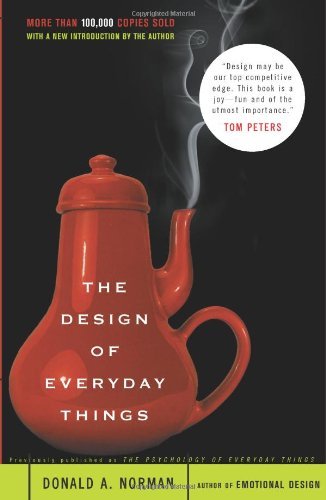 goodreads, wiki, amazon
openarchive, gutenberg
authors:
- Donald A. Norman
pdf links:
- https://faculty.cc.gatech.edu/~stasko/6750/Talks/08-doet.pdf
- https://dl.icdst.org/pdfs/files4/4bb8d08a9b309df7d86e62ec4056ceef.pdf
- https://vpb.smallyu.net/[Type]%20books/The%20Design%20of%20Everyday%20Things%20-%20Don%20Norman.pdf
- https://media.aanda.psu.edu/sites/media/aa/files/documents/norman_design-of-everyday-things.pdf
goodreads, wiki, amazon
openarchive, gutenberg
authors:
- Donald A. Norman
pdf links:
- https://faculty.cc.gatech.edu/~stasko/6750/Talks/08-doet.pdf
- https://dl.icdst.org/pdfs/files4/4bb8d08a9b309df7d86e62ec4056ceef.pdf
- https://vpb.smallyu.net/[Type]%20books/The%20Design%20of%20Everyday%20Things%20-%20Don%20Norman.pdf
- https://media.aanda.psu.edu/sites/media/aa/files/documents/norman_design-of-everyday-things.pdf
Short Description
"The Design of Everyday Things" by Donald A. Norman explores the principles of user-centered design, highlighting how thoughtful design bridges the gap between objects and user experience through intuitive interfaces, feedback, and affordances. Norman emphasizes the importance of usability and the psychological aspects that influence how people interact with products.
Goodreads Description
The ultimate guide to human-centered design Even the smartest among us can feel inept as we fail to figure out which light switch or oven burner to turn on, or whether to push, pull, or slide a door. The fault, argues this ingenious -- even liberating -- book, lies not in ourselves, but in product design that ignores the needs of users and the principles of cognitive psychology. The problems range from ambiguous and hidden controls to arbitrary relationships between controls and functions, coupled with a lack of feedback or other assistance and unreasonable demands on memorization. The Design of Everyday Things shows that good, usable design is possible. The rules are make things visible, exploit natural relationships that couple function and control, and make intelligent use of constraints. The guide the user effortlessly to the right action on the right control at the right time. The Design of Everyday Things is a powerful primer on how -- and why -- some products satisfy customers while others only frustrate them.
AI Summary
"The Design of Everyday Things" by Donald A. Norman is a seminal work in the field of design, particularly focusing on the relationship between the user and everyday objects. It advocates for user-centered design and provides principles for creating intuitive, user-friendly products. Below is a summary of the key ideas in the book, along with bullet points highlighting the main concepts:
Key Ideas:
-
Human-Centered Design:
- Design should prioritize the needs and capabilities of users.
- Good design is inclusive and considers the diverse range of potential users.
-
The Psychology of User Experience:
- Understanding human psychology is crucial for designing intuitive products.
- Users should be able to use products without needing extensive instructions.
-
Principles of Good Design:
- Norman identifies several principles that guide effective design:
- Visibility: Important elements should be easily visible to the user.
- Feedback: Users must receive prompt and clear feedback about their actions.
- Constraints: Design should naturally restrict possibilities to prevent errors.
- Mapping: The relationship between controls and their effects should be clear and logical.
- Consistency: Consistent design elements help users understand and predict behavior.
- Affordance: Objects should suggest their purpose and use through their design.
- Norman identifies several principles that guide effective design:
-
Error and Error Prevention:
- Design should anticipate potential user errors and seek to minimize them.
- Error prevention can be achieved through thoughtful constraints and fail-safes.
-
Iterative Design Process:
- Design is an iterative process that involves prototyping, testing, and refinement.
- Feedback from real users is essential to improving designs.
-
Gulf of Execution and Gulf of Evaluation:
- These concepts describe the differences between user intentions and what can be done with a device (execution), and what is perceived versus what is actually happening (evaluation).
- The goal of good design is to bridge these gulfs.
Bullet Points:
- Visibility: Controls should be easily identifiable and relevant information readily available.
- Feedback: Provide immediate and comprehensible responses to user actions.
- Constraints: Implement natural, physical, cultural, or logical constraints to guide user interaction.
- Mapping: Design should ensure a clear relationship between controls and their results.
- Consistency: Use uniform design language across products for ease of use.
- Affordance: Ensure that the appearance of an object suggests its function.
- Iterative Design: Emphasizes revision and user testing as core to developing effective designs.
- User Errors: Design should accommodate and prevent possible user errors through intuitive interfaces.
Norman highlights throughout the book that the complexities and frustrations users often face with everyday objects stem more from poor design than from user incompetence. The primary goal of good design is to make life easier and more enjoyable by creating products that are not only functional but also user-friendly, ensuring the everyday things we interact with serve us efficiently and effectively.
Bertrand Russell Summary
"The Design of Everyday Things" by Donald A. Norman is a lucid exploration of the principles governing the interaction between humans and the objects they encounter daily. In my analysis, the text can be regarded as a foundational treatise on human-centered design, a philosophy profoundly vital in our intricate modern society where technology increasingly infiltrates every aspect of life.
Norman posits that the allure of an object cannot merely rest on its aesthetic appeal; rather, it must extend to embrace usability, a notion that aligns with my belief in the necessity of practical reason. As with the philosophical pursuit of knowledge, the design of objects must serve a purpose, catering not only to the intellectual elite but to the commonality of mankind as well.
Central to Norman's thesis is the concept of the "affordance" of objects, which refers to the properties that signal their utility to users. This perspective reinforces the idea that clarity in communication should extend beyond spoken or written language into the realm of the tactile and visual. Furthermore, Norman introduces the notion of the "feedback loop," drawing a parallel to the iterative nature of philosophical inquiry where constant reflection leads to improved understanding and functionality.
Norman’s discourse also addresses the pitfalls of poor design, which he equates to the errors in logic that obfuscate truth. Such design failures are not merely inconveniences but are akin to irrational belief systems that hinder human progress and satisfaction. By highlighting the importance of intuitive design, Norman advocates for a world where human interaction with everyday objects is as rational and seamless as the most elegant philosophical argument.
Norman's work culminates in a call to re-evaluate how we conceive and construct our physical world. This echoes the philosophical imperative to not merely accept the world as it is but to strive for a vision of what it could be, shaped by the powers of reason and creativity. In essence, "The Design of Everyday Things" is not merely a guide for designers, but a manifesto urging us to contemplate how the design of objects can enhance or impede the serenity of the human experience—a pursuit that bears remarkable similarity to the relentless quest for wisdom itself.
In summation, Norman’s text should be viewed as an essential companion to anyone engaging with the practical and philosophical design of life’s myriad interactions. It equips us with the tools to improve not only our craft and constructions but ultimately, our enjoyment and understanding of the very world we inhabit.
Synopsys
https://jnd.org/books/the-design-of-everyday-things-revised-and-expanded-edition/ Chapters
- Psychopathology of Everyday Things
- The Psychology of Everyday Actions
- Knowledge in the Head and in the World
- Knowing What to Do: Constraints, Discoverability, and Feedback
- Human Error? No, Bad Design
- Design Thinking
- Design in the World of Business
Full Table of Contents
Psychopathology of Everyday Things
The Complexity of Modern Devices
Human-Centered Design
-
Fundamental Principles of Interaction
- Affordances
- Signifiers
- Affordances, Perceived Affordances, and Signifiers
- Affordances and Signifiers: A Conversation
- Mapping
- Feedback
- Conceptual Models
The System Image
The Paradox of Technology
The Design Challenge
2. The Psychology of Everyday Actions
- How People Do Things: the Gulfs of Execution and Evaluation
- The Seven Stages of Action
- Human Thought: Mostly Subconscious
- Human Cognition and Emotion
- The Visceral Level
- The Behavioral Level
- The Reflective Level
- Design Must Take place at All levels: Visceral, Behavioral, and Reflective
- The Seven Stages of Action and the Three Levels of Processing
- People As Explanatory Creatures
- Blaming the Wrong Things
- Learned Helplessness
- Positive Psychology
- Falsely Blaming Yourself
- How Technology Can Accommodate Human Behavior
- Providing a Conceptual Model for a Home Thermostat
- Entering Dates, Times and Telephone Numbers
- The Seven Stages Of Action: Seven Fundamental Design Principles
3. Knowledge in the Head and in the World
- Precise Behavior From Imprecise Knowledge
- Knowledge Is In The World
- When Precision Is Unexpectedly Required
- Constraints Simplify Memory
- Memory Is Knowledge In The Head
- The Structure of Memory
- Short-Term or Working Memory
- Long-Term Memory
- Memory for Arbitrary and Meaningful Things
- Approximate Models: Memory in the Real World
- Example 1: Converting Temperatures between Fahrenheit and Celsius
- Example 2: A Model of Short-Term Memory
- Example 3: Steering a Motorcycle
- Example 4: “Good Enough” Arithmetic
- Scientific Theory Versus Everyday Practice
- Combining Knowledge in the World With Knowledge in the Head
- How Pilots Remember What Air Traffic Control Tells Them
- Reminding: Prospective Memory
- The Tradeoff between Knowledge In The World and in the Head
- Memory in Multiple Heads, Multiple Devices
- Natural Mapping
- Culture and Design: Natural Mappings Can Vary With Culture
4. Knowing What to Do: Constraints, Discoverability, and Feedback
- Four Kinds of Constraints: Physical, Cultural, Semantic, and Logical
- Physical Constraints
- Cultural Constraints
- Semantic Constraints
- Logical Constraints
- Cultural Norms, Conventions, and Standards
- Applying Affordances, Signifiers, and Constraints to Everyday Objects
- The Problem with Doors
- The Problem with Switches
- Activity-Centered Controls
- Constraints That Force the Desired Behavior
- Forcing Functions
- Interlocks
- Lock-ins
- Lock-outs
- Conventions, Constraints, and Affordances
- Conventions Are Cultural Constraints
- When Conventions Change: The Case of Destination Control Elevators
- Peoples’ Responses to Changes in Conventions
- The Faucet: A Case History of Design
- Using Sound as Signifiers
- When Silence Kills
5. Human Error? No, Bad Design
- Understanding Why There Is Error
- Root Cause Analysis
- Root Cause Analysis: The Five Whys
- Deliberate Violations
- Two Types of Errors: Slips and Mistakes
- Definitions: Errors, Slips, and Mistakes
- Slips
- Mistakes
- Error and the Seven Stages of Action
- The Classification of Slips
- Capture Slips
- Description-Similarity Slips
- Memory Lapse Slips
- Mode Error Slips
- The Classification of Mistakes
- Rule-Based Mistakes
- Knowledge-Based Mistakes
- Memory-Lapse Mistakes
- Social and Institutional Pressures
- Checklists
- Reporting Error
- Case Study: Jidoka — How Toyota Handles Error
- Poka Yoke: Error Proofing
- NASA’s Aviation Safety Reporting System
- Detecting Errors
- Explaining Away Mistakes
- The Case of the Wrong Turn on a Highway
- In Hindsight, Events Seem Logical, even if Beforehand they Were Not Predicted
- Designing for Error
- Design Lessons from the Study of Errors
- Adding Constraints to Block Errors
- Undo
- Confirmation and Error Messages
- A slip leads me to close the wrong window
- A mistake leads me to close the wrong window
- Sensibility Checks
- Minimizing slips
- The Swiss Cheese Model of How Errors Lead to Accidents
- When Good Design Isn’t Enough
- When People Really Are at Fault
- Resilience Engineering
- The Paradox of Automation
- Design Principles for Dealing with Error
6. Design Thinking
- Solving the Correct Problem
- The Double Diamond Model of Design
- The Human-Centered Design Process
- Observation
- Design Research versus Market Research
- Idea Generation
- Prototyping
- Testing
- Iteration
- Activity-Centered versus Human-Centered Design
- On the Differences between Tasks and Activities
- Iterative Design versus Linear Stages
- Observation
- What I Just Told You? It Doesn’t Really Work That Way
- Norman’s Theorem of Product Development
- The Design Challenge
- Products Have Multiple, Conflicting Requirements
- Designing for Special People
- The Stigma Problem
- Complexity Is Good; It Is Confusion That Is Bad
- Standardization and Technology
- Establishing Standards
- Why Standards Are Necessary: A Simple Illustration
- A Standard That Took So Long, Technology Overran It
- A Standard That Never Caught On: Digital Time
- Deliberately Making Things Difficult
- Design: Developing Technology for People
7. Design in the World of Business
- Competitive Forces
- Featuritis: A Deadly Temptation
- New Technologies Force Change
- How Long Does It Take to Introduce a New Product?
- Video Phone: Conceived in 1879 – Still Not Here
- The Long Process of Development of the Typewriter Keyboard
- Two Forms of Innovation: Incremental and Radical
- Incremental Innovation
- Radical Innovation
- The Design of Everyday Things: 1988 – 2038
- As Technologies Change Will People Stay the Same?
- Things That Make Us Smart
- The Future of Books
- The Moral Obligations of Design
- Needless Features, Needless Models. Good for Business, Bad for the Environment
- Final Thoughts
- The Rise of the Small
- As the World Changes, What Stays the Same?
8. End Matter
- Afterward/Acknowledgments
- Readings and Notes
- References
Notes
Original Content
- https://www.goodreads.com/book/show/840.The_Design_of_Everyday_Things
- wiki
- amazon
- openarchive
- gutenberg
- Donald A. Norman
- https://faculty.cc.gatech.edu/~stasko/6750/Talks/08-doet.pdf
- https://dl.icdst.org/pdfs/files4/4bb8d08a9b309df7d86e62ec4056ceef.pdf
- https://vpb.smallyu.net/[Type]%20books/The%20Design%20of%20Everyday%20Things%20-%20Don%20Norman.pdf
- https://media.aanda.psu.edu/sites/media/aa/files/documents/norman_design-of-everyday-things.pdf
- https://jnd.org/books/the-design-of-everyday-things-revised-and-expanded-edition/
- Preface (click to read)