The Art of Doing Science and Engineering by Hamming
The Art of Doing Science and Engineering by Hamming
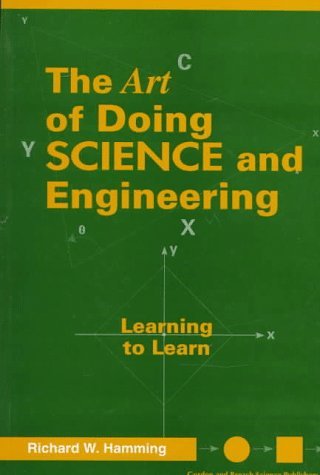
uuid: 20250221003810648917 title: "The Art of Doing Science and Engineering: Learning to Learn" main-author: "Richard Hamming" tags: - "#book"
- "#unclassified"
 goodreads, wiki, amazon
openarchive, gutenberg
authors:
- Richard Hamming
pdf links:
- https://blas.com/wp-content/uploads/2019/07/The-Art-of-Doing-Science-and-Engineering.pdf
- https://github.com/media-lib/prog_lib/blob/master/Hamming-TheArtOfDoingScienceAndEngineering.pdf
- https://worrydream.com/refs/Hamming1997-TheArtofDoingScienceand_Engineering.pdf
goodreads, wiki, amazon
openarchive, gutenberg
authors:
- Richard Hamming
pdf links:
- https://blas.com/wp-content/uploads/2019/07/The-Art-of-Doing-Science-and-Engineering.pdf
- https://github.com/media-lib/prog_lib/blob/master/Hamming-TheArtOfDoingScienceAndEngineering.pdf
- https://worrydream.com/refs/Hamming1997-TheArtofDoingScienceand_Engineering.pdf
Short Description
"The Art of Doing Science and Engineering: Learning to Learn" by Richard Hamming is a profound exploration of the creative and intellectual processes behind scientific discovery and engineering innovation. Melding historical insights with practical strategies, Hamming emphasizes the importance of curiosity, problem-solving, and the relentless pursuit of understanding to foster a mindset optimized for learning and breakthroughs.
Goodreads Description
Highly effective thinking is an art that engineers and scientists can be taught to develop. By presenting actual experiences and analyzing them as they are described, the author conveys the developmental thought processes employed and shows a style of thinking that leads to successful results is something that can be learned. Along with spectacular successes, the author also conveys how failures contributed to shaping the thought processes.Provides the reader with a style of thinking that will enhance a person's ability to function as a problem-solver of complex technical issues. Consists of a collection of stories about the author's participation in significant discoveries, relating how those discoveries came about and, most importantly, provides analysis about the thought processes and reasoning that took place as the author and his associates progressed through engineering problems.
AI Summary
Certainly! "The Art of Doing Science and Engineering: Learning to Learn" by Richard Hamming is a thought-provoking exploration of the creative and intellectual processes involved in scientific and engineering work. Hamming, known for his pioneering contributions to computer science and telecommunications, shares insights into how to think effectively, solve difficult problems, and foster innovation. Below is a summary of the key ideas from the book:
-
Learning to Learn:
- Emphasizes the importance of developing a mindset focused on continuous learning and growth.
- Encourages readers to cultivate curiosity and an ability to adapt to new information and challenges.
-
Creative Problem Solving:
- Hamming discusses techniques for approaching and solving complex problems creatively.
- Suggests leveraging analogies, questioning assumptions, and breaking problems into parts.
-
Interdisciplinary Thinking:
- Stresses the value of drawing on knowledge from multiple fields to enhance understanding and innovation.
- Promotes cross-disciplinary collaboration as a way to tackle complex challenges.
-
The Importance of Communication:
- Highlights the necessity of being able to communicate technical ideas clearly and persuasively.
- Suggests that effective communication can amplify the impact of scientific and engineering discoveries.
-
Time Management and Prioritization:
- Advises on the strategic use of time to focus on problems that matter most.
- Encourages setting priorities and using time efficiently to maximize productivity.
-
Risk and Failure:
- Explores the inevitability of failure in the pursuit of significant achievements.
- Discusses the importance of taking calculated risks and learning from failures to advance knowledge.
-
Ethical Considerations:
- Acknowledges the ethical responsibilities of scientists and engineers in the impact their work has on society.
- Urges consideration of the broader implications of scientific and technological advancements.
-
Case Studies and Historical Examples:
- Provides numerous examples from Hamming’s own career and famous scientific breakthroughs to illustrate his points.
- Encourages learning from past successes and failures as a way to guide current and future efforts.
-
Personal Anecdotes and Reflections:
- Shares personal experiences and lessons learned throughout Hamming’s career.
- Offers insight into the mindset and habits of successful scientists and engineers.
-
Legacy and Impact:
- Challenges readers to think about the long-term impact of their work.
- Encourages striving for work that leaves a lasting and meaningful contribution.
"The Art of Doing Science and Engineering" is a compelling guide for anyone interested in developing a deeper understanding of how great scientists and engineers think, work, and achieve extraordinary results. Through his experiences and reflections, Hamming provides valuable advice for anyone looking to make significant contributions in their field.
Bertrand Russell Summary
"The Art of Doing Science and Engineering: Learning to Learn" by Richard Hamming presents itself as an intellectual voyage, a reflection on the processes that underpin scientific discovery and engineering innovation. As one examines this literary construct, one is immediately aware of the author's reverence for the interdisciplinary synergy inherent in academic pursuit. Hamming espouses an ideology wherein learning is not merely an act of consumption of knowledge, but an act of creation and fabrication, pressing upon the reader the necessity of cultivating a scientific vision.
The text weaves through the landscapes of mathematics, physics, and computer science, much like an artisan traversing the domains of his craft, borrowing techniques where they prove efficacious. Hamming posits that solving problems is a matter of perception as much as it is of technical competence. This philosophical stance harkens back to my own contemplations on the nature of knowledge and the manner in which it is acquired and refined.
One cannot overlook Hamming's emphasis on the need for intuition in mathematical and scientific endeavors. He argues that intuition acts as a beacon, guiding the practitioner through the fog of the unknown, an assertion that resonates profoundly with the existential reality of scientific pursuit. Intuition, as Hamming illustrates, is not a divine gift bestowed upon the fortunate but a faculty honed through relentless curiosity and rigorous study.
The author frequently alludes to the importance of error and failure in the learning process. It is a refreshing echo of my assertion that the acknowledgment of human fallibility is the bedrock of intellectual progress. By confronting our own limitations, we pave the way for true enlightenment and the advancement of human thought.
In Hamming's discourse, there is an implicit encouragement towards the cultivation of a mind unshackled by the dogma of traditional approaches. He critiques the rote methodologies of learning and champions the cause of originality, urging practitioners to transcend conventional paradigms and to venture into the realms of the hypothetical and the speculative.
In conclusion, Richard Hamming's "The Art of Doing Science and Engineering: Learning to Learn" serves as a profound treatise on intellectual humility and the relentless pursuit of understanding. His examination of the intersections between theoretical abstraction and practical implementation illuminates the need for a holistic approach to the sciences. It is a call to arms for those who would seek not only to know but to understand the wondrous intricacies of the universe. Thus, Hamming's work stands as a testament to the enduring spirit of inquiry that propels the collective human endeavor onward, a sentiment to which I am most sympathetic.
Notes
Original Content
- https://www.goodreads.com/book/show/530415.The_Art_of_Doing_Science_and_Engineering
- wiki
- amazon
- openarchive
- gutenberg
- Richard Hamming
- https://blas.com/wp-content/uploads/2019/07/The-Art-of-Doing-Science-and-Engineering.pdf
- https://github.com/media-lib/prog_lib/blob/master/Hamming-TheArtOfDoingScienceAndEngineering.pdf
- https://worrydream.com/refs/Hamming1997-TheArtofDoingScienceand_Engineering.pdf