ignition by clark
ignition by clark
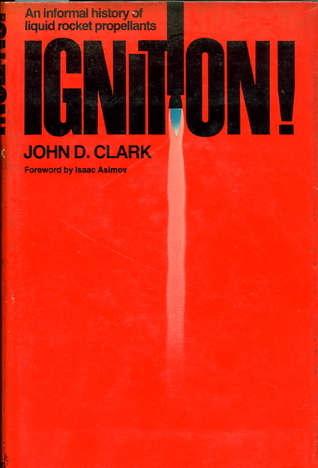
title: "Ignition!: An informal history of liquid rocket propellants" main-author: "John Drury Clark" tags:
- #book
 goodreads, wiki, amazon
openarchive, gutenberg
authors:
- John Drury Clark
- John Drury Clark
pdf links:
- https://library.sciencemadness.org/library/books/ignition.pdf
goodreads, wiki, amazon
openarchive, gutenberg
authors:
- John Drury Clark
- John Drury Clark
pdf links:
- https://library.sciencemadness.org/library/books/ignition.pdf
Short Description
"Ignition!: An Informal History of Liquid Rocket Propellants" by John Drury Clark provides an irreverent, behind-the-scenes look at the perilous quest for effective rocket fuels during the Cold War. This memoir-like history details the intense competition among scientists and labs as they developed explosive propellants, ultimately enabling space exploration and satellite deployment.
Goodreads Description
Ignition! is the inside story of the Cold War era search for a rocket propellant that could be trusted to take man into space. A favorite of Tesla and SpaceX founder Elon Musk, listeners will want to tune into this "really good book on rocket[s]," available for the first time in audio.Ignition! is the story of the search for a rocket propellant which could be trusted to take man into space. This search was a hazardous enterprise carried out by rival labs who worked against the known laws of nature, with no guarantee of success or safety.Acclaimed scientist and sci-fi author John Drury Clark writes with irreverent and eyewitness immediacy about the development of the explosive fuels strong enough to negate the relentless restraints of gravity. The resulting volume is as much a memoir as a work of history, sharing a behind-the-scenes view of an enterprise that eventually took men to the moon, missiles to the planets, and satellites to outer space. A classic work in the history of science, listeners will want to get their hands on this influential classic, available for the first time in decades.
AI Summary
"Ignition!: An Informal History of Liquid Rocket Propellants" by John D. Clark is a detailed yet accessible account of the development of liquid rocket propellants in the mid-20th century. Written with humor and engaging anecdotes, the book covers the scientific and technical challenges faced by chemists and engineers as they experimented with various volatile and often dangerous substances to create effective rocket fuels.
Clark, a chemist who worked in the field, provides insights into both the successes and failures that characterized early rocket propulsion research. He discusses the various types of rocket propellants developed during this period, including the more exotic and hazardous ones, and the reasons some were eventually chosen over others.
The book also highlights the interdisciplinary nature of this endeavor—requiring a combination of chemistry, engineering, and physics—and sheds light on the iterative process of scientific experimentation and discovery. Despite the technical nature of the subject, Clarke's writing is accessible and peppered with humor, making the complex material understandable and engaging for both lay readers and those with a scientific background.