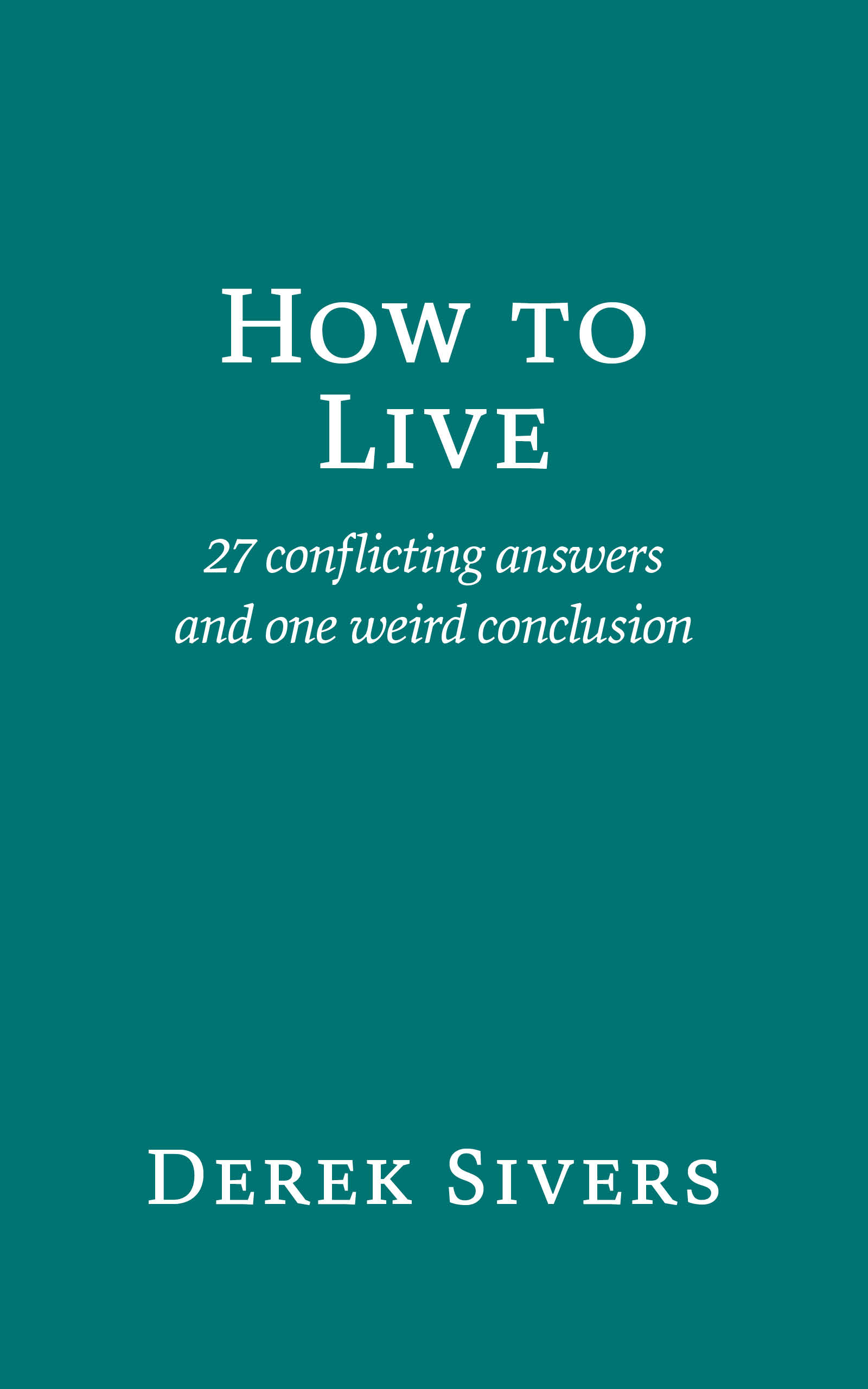
How to Live by Derek Sivers
How to Live by Derek Sivers
uuid: 20250221004522150134 title: "How to Live: 27 conflicting answers and one weird conclusion" main-author: "Derek Sivers" tags: - "#book"
- "#unclassified"
 goodreads, wiki, amazon
openarchive, gutenberg
authors:
- Derek Sivers
pdf links:
- https://docdrop.org/pdf/Sivers-HowtoLive-8na1u.pdf
- https://docdrop.org/downloadannotationdoc/Sivers-HowtoLive-8na1u.pdf
goodreads, wiki, amazon
openarchive, gutenberg
authors:
- Derek Sivers
pdf links:
- https://docdrop.org/pdf/Sivers-HowtoLive-8na1u.pdf
- https://docdrop.org/downloadannotationdoc/Sivers-HowtoLive-8na1u.pdf
Short Description
"How to Live: 27 Conflicting Answers and One Weird Conclusion" by Derek Sivers explores diverse life philosophies through 27 perspectives, offering insight into living well while embracing life's contradictions, culminating in an unexpected synthesis.
Goodreads Description
Not quite non-fiction, not quite self-help. It’s a work of art about conflicting philosophies. Many books believe they know how you should live.But each book disagrees with the next.In “How to Live”, each chapter believes it knows how you should live.And each chapter disagrees with the next.One chapter makes a compelling argument for why you should be completely independent, keeping all options open. The next chapter argues why you should commit to one career, one place, and one person.One chapter persuades you to be fully present, and experience each moment. The next, to delay gratification and invest for the future.Which one is right? Which does the author believe? All of them. It's a philosophy of conflicting philosophies.A very unique and thought-provoking book.Meant for reflection as much as instruction.113 incredibly succinct pages of profound insights.No philosophers are quoted.No -isms are named.Only actionable directives.The end result feels more like poetry than prose.
AI Summary
Certainly! "How to Live: 27 Conflicting Answers and One Weird Conclusion" by Derek Sivers is a unique book that explores various life philosophies and perspectives, showing how different ways of living can lead to fulfilling lives. Here's a summary with key ideas and bullet points:
Key Ideas:
Multiplicity of Life Philosophies: The book presents 27 different approaches to living a meaningful life, each offering its own perspective and wisdom. Each chapter outlines a distinct philosophy, showing how it could be the definitive answer to the question of how to live well.
Conflicting Answers: The chapters intentionally present conflicting advice, highlighting that life is not one-size-fits-all and that success and fulfillment can be achieved in numerous ways.
Exploration of Paradoxes: Sivers embraces the paradoxes inherent in living, acknowledging that opposing truths can both be valid depending on context and individual circumstances.
Subjectivity and Personal Choice: The book emphasizes the importance of personal choice in determining which life philosophy resonates most with the reader's values, desires, and situation.
Theme of Balance: Many chapters address the idea of balance — such as balancing freedom with responsibility, or ambition with contentment — and the challenge of finding equilibrium in complex lives.
Bullet Points of the 27 Philosophies:
- Be Independent: Prioritize self-reliance and personal freedom.
- Be a Yes Man: Say yes to opportunities and experiences.
- Be a No Man: Learn to say no to preserve focus and integrity.
- Think Long Term: Focus on long-term goals and delayed gratification.
- Be Spontaneous: Embrace spontaneity and live in the moment.
- Pursue Passion: Follow your passions diligently.
- Master a Skill: Strive for mastery in a particular skill or domain.
- Balance Work and Family: Prioritize personal relationships alongside professional pursuits.
- Maintain Work Ethic: Value hard work and disciplined effort.
- Seek Happiness: Pursue what makes you happy.
- Pursue Success: Set and achieve ambitious goals.
- Seek Simplicity: Downsize and simplify life to focus on what matters.
- Seek Security: Value stability and safety.
- Be Adventurous: Embrace risk and challenge.
- Be Content: Practice gratitude and contentment in the here and now.
- Increase Wealth: Focus on financial accumulation and security.
- Emphasize Health: Prioritize physical and mental well-being.
- Focus on Relationships: Build nurturing and meaningful connections.
- Gain Power: Seek influence and control to shape your environment.
- Seek Knowledge: Be a lifelong learner and seeker of truth.
- Serve Others: Focus on altruism and helping those around you.
- Focus on Self: Prioritize self-care and personal growth.
- Embrace Change: Adapt and evolve with changing circumstances.
- Seek Stability: Find consistency and routine.
- Think Small: Cherish simple pleasures and everyday moments.
- Think Big: Dream big and pursue radical achievements.
- Finally, Live a Contradictory Life: Accept and embrace contradictions, knowing that life’s complexity is its beauty.
Conclusion: The Weird Conclusion
- Embrace Complexity: In the end, Sivers suggests that the answer to "how to live" is not one path or philosophy but the acceptance that life's richness comes from its complexity and contradictions. It's about integrating different philosophies in ways that suit the individual and acknowledging that conflicting answers can coexist.
The book encourages readers to explore these various philosophies and reflect on how different perspectives might contribute to a richer life experience, urging them to define and continuously redefine what it means to live a good life according to their own terms.
Bertrand Russell Summary
Title: A Philosophical Inquiry into 'How to Live: 27 Conflicting Answers and One Weird Conclusion' by Derek Sivers
In the realm of philosophical inquiry, human beings have perpetually sought answers to the perennial question: "How ought one to live?" Derek Sivers' book, How to Live: 27 Conflicting Answers and One Weird Conclusion, is a modern contribution to this enduring quest, offering a compendium of perspectives that delineate various approaches toward a life well-lived. Through the enumeration of divergent paths, Sivers embarks on an exploration reminiscent of the multiplicity often found within philosophical discourse.
Sivers' work can be seen as an exposition of life's manifold possibilities, examined through 27 ostensibly conflicting paradigms. Each of these paradigms presents a unique prescription, akin to a philosophical doctrine, suggesting a particular mode of existence. The reader is invited to traverse these mental landscapes, which range from the ascetic to the hedonistic, the altruistic to the egocentric, thus encountering a microcosm of human thought.
One is reminded, in engaging with Sivers, of the dialectical method favored by Socratic philosophy, wherein conflicting ideas are brought into juxtaposition to illuminate truth. Instead of dictating a singular objective path, Sivers relinquishes the role of the dogmatist in favor of that of a guide, allowing individuals the autonomy to discern which, if any, of these modes resonate with their own existential predilections.
The conclusion, described as "weird" by Sivers, posits a meta-perspective on the conflict inherent in these diverse answers. Herein lies the paradox: the final supposition suggests that the very act of choosing—along with the acceptance of intrinsic contradictions—is the essence of living. This conclusion aligns itself with broader existential themes, recognizing the unique human capacity for choice amidst the chaos of competing values.
For the philosopher especially attuned to the contradictions inherent in human life, Sivers delivers not a prescriptive moral edict but an invitation to philosophical contemplation. His work emphasizes the importance of personal agency and the necessity of engaging with life's variability in a manner that is intellectually honest and personally meaningful.
In sum, Derek Sivers' How to Live serves as an invitation to embrace the philosophical endeavor of defining a life course amidst the cacophony of possible answers. It resonates with the spirit of philosophical inquiry itself—an unending journey through the landscape of human thought, seeking understanding without necessarily demanding conclusion. For those who value the journey of interrogation over definitive doctrines, Sivers provides rich material for reflection on the art of living.