Envisioning Information by Tufte
Envisioning Information by Tufte
uuid: 20250221150703634165 title: "Envisioning Information main-author: "Edward R. Tufte" tags: - "#Book" - "#Design"
- "#Tier2"
 goodreads, wiki, amazon
openarchive, gutenberg
goodreads, wiki, amazon
openarchive, gutenberg
authors: - Edward R. Tufte
pdf links: - pdf_1 - pdf_3 - pdf_2
Short Description
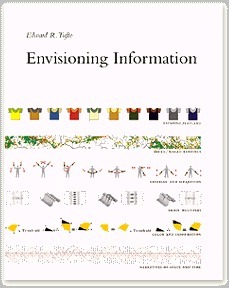
- Representing n-dimensional data on a 2D surface (Escape from Flatland)
- Micro/Macro readings
- Layering and separation
- Small multiples
- Color and information
- Narratives of space and time
Goodreads Description
The celebrated design professor here tackles the question of how best to communicate real-life experience in a two-degree format, whether on the printed page or the computer screen. The Whole Earth Review called Envisioning Information a "passionate, elegant revelation."
AI Summary
Certainly! Here is a summary of "Envisioning Information" by Edward R. Tufte, highlighting key ideas and concepts from the book:
Overview: "Envisioning Information" is a comprehensive exploration into the design and presentation of complex information in a visually engaging manner. Edward R. Tufte delves into various techniques and principles for conveying data clearly and effectively through visual means.
Key Ideas:
-
Visual Clarity and Complexity:
- Tufte discusses the balance between clarity and complexity in information design.
- Effective representation allows for a high density of data to be presented clearly, enabling viewers to discern patterns, structures, and relationships.
-
Escape from Flatland:
- Explores the challenge of representing three-dimensional data or higher-dimensional data on two-dimensional displays.
- Encourages designers to create representations that help people understand complex, multidimensional information.
-
Micro/Macro Readings:
- Highlights the importance of integrating detailed micro-level information with an overarching macro-level view.
- Viewers should be able to see both overall trends and minute details simultaneously.
-
Layering and Separation:
- Effective use of layering and separation helps prevent visual clutter.
- Different methods such as changing colors, using white space, and creating distinct layers can aid in better information separation.
-
Small Multiples:
- Introduces the concept of small multiples, a series of similar graphs or images, which allows comparisons and reveals evidence of changes or differences.
- Facilitates easy comparison by keeping design consistent across each representation.
-
Color and Information:
- Explores the strategic use of color in conveying information accurately.
- Color should enhance data understanding, not distract or mislead viewers. Proper use of color maximizes cognitive functionality.
-
Narratives of Space and Time:
- Discusses techniques for effectively displaying information that spans over time and space.
- Visual narratives should maintain continuity to provide the context and details necessary for understanding temporal data.
-
Credibility and Evaluation:
- Effective visual design should be honest and reliable, providing an accurate depiction of the data.
- Information presentation should prevent any misinterpretation or distortion.
Conclusion:
"Envisioning Information" is a seminal work in the field of information design and visualization. Tufte emphasizes the importance of using visual tools to make complex information accessible and intelligible. His principles guide designers in creating clear and effective visual representations that enhance communication and understanding.
Bertrand Russell Summary
"Envisioning Information" by Edward R. Tufte is an exploration of the visualization of data, a topic that resonates deeply with the philosophical pursuit of clarity and elegant simplicity in the representation of complex ideas. Tufte's work is a rich tapestry of theory and practice, woven together to reveal the manifold ways in which the human intellect can transcend the limitations of traditional modes of information presentation.
At the heart of Tufte's thesis is the conviction that the presentation of data must adhere to principles that respect both aesthetic beauty and functional clarity. The book strives to depict the nobility to be found in simplicity, reminiscent of the logical atomism I have long espoused. Tufte's guiding philosophy is one of stripping away superfluities, of revealing the underlying structure of information in its most lucid form, a pursuit akin to my own endeavors in logical analysis.
Throughout "Envisioning Information," Tufte delineates numerous principles that enhance our capacity to visualize and understand data. By employing techniques such as small multiples, layering, and separation, and the use of micro and macro readings, he demonstrates how we might escape the tyranny of flat, unimaginative data representation. These methods reflect the analytical rigor and creative insight required to illuminate complex truths, a parallel to the philosophical aspiration of delineating logical form from linguistic opacity.
Perhaps one of Tufte’s seminal contributions is his insistence on the ethical responsibility inherent in information design. Here, we find a moral dimension in presenting data honestly and transparently, reminiscent of the ethical considerations in logical positivism and scientific inquiry. By illuminating the ethical implications of design, Tufte challenges us to consider the veracity and integrity of our communicative efforts.
One must appreciate the visual elements permeating the text, as Tufte fills his work with myriad examples—illustrations that serve not merely as decoration, but as substantive enhancements of his arguments. This interplay of text and image forms a philosophical dialogue, engaging the reader in a distinctly empirical experience of theory in practice.
In sum, Tufte's "Envisioning Information" is a masterful exposition on the art of information design, yielding insights that transcend its immediate domain to touch upon perennial philosophical concerns about clarity, truth, and beauty. It is a testament to the intellectual potential residing at the intersection of aesthetics and analytics, encouraging us all to aspire to convey information with the elegance it deserves.