Electrons and Holes in Semiconductors by William Shockley
Electrons and Holes in Semiconductors by William Shockley
uuid: 20250221031328944397 title: Electrons and holes in semiconductors, with applications to transistor electronics main-author: "William Shockley" tags: - "#book"
- "#unclassified"
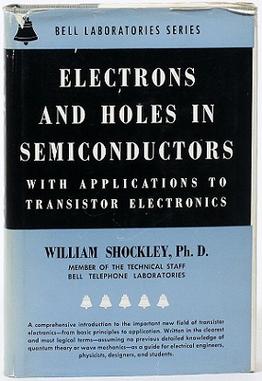 goodreads, wiki, amazon
openarchive, gutenberg
goodreads, wiki, amazon
openarchive, gutenberg
authors: - William Shockley
pdf links: - pdf_1 - pdf_2 - pdf_3 - pdf_4 - pdf_5
Short Description
"Electrons and Holes in Semiconductors" by William Shockley offers a foundational exploration of semiconductor physics, focusing on electron and hole dynamics, and their critical role in the operation of transistors and modern electronics.
Goodreads Description
PRODUCT IS A HARDBACK BOOK THAT HAS BEEN IN STORAGE WITH SOME WEAR TO COVER.
AI Summary
"Electrons and Holes in Semiconductors, with Applications to Transistor Electronics" by William Shockley is a foundational text in semiconductor physics and transistor technology. The book, published in the early stages of the semiconductor revolution, provides a detailed exploration of the behavior of electrons and holes in semiconductor materials, which are crucial for understanding and engineering electronic devices. Below is a summary with key ideas and points:
Summary
-
Introduction to Semiconductors:
- Explains the basic properties of semiconductor materials, distinguishing them from conductors and insulators.
- Introduces the concept of a band structure and energy gaps.
-
Electrons and Holes:
- Details the roles of electrons and holes as charge carriers in semiconductors.
- Describes the generation and recombination processes of electrons and holes.
- Explains the concept of intrinsic and extrinsic semiconductors.
-
Conductivity and Mobility:
- Discusses electrical conductivity in semiconductors and how it is influenced by temperature and impurities.
- Introduces the concept of carrier mobility and its importance in semiconductor performance.
-
Semiconductor Junctions:
- Explains p-n junctions and their essential role in semiconductor devices.
- Describes the formation of depletion regions and the behavior of junctions under forward and reverse bias.
-
Transistor Principles:
- Introduces the basic operation of bipolar junction transistors (BJTs).
- Explains the function of n-p-n and p-n-p transistors and their characteristics.
- Discusses how transistors can be used to amplify signals and switch electronic currents.
-
Applications to Electronics:
- Explores the application of semiconductor principles in designing and improving transistor electronics.
- Provides examples of how transistors are integrated into circuits for various functionalities.
Key Ideas
Semiconductors are crucial materials: Understanding their electrical properties is fundamental for the development of electronic devices.
Charge carriers are pivotal: Electrons and holes are responsible for current flow in semiconductors.
Doping enhances performance: Introducing impurities into semiconductors modulates their electrical characteristics, enabling the control of conductivity.
Junctions are fundamental components: p-n junctions are the building blocks for many semiconductor devices, including diodes and transistors.
Transistors revolutionize electronics: They serve as building blocks for amplifying and switching electronic signals, paving the way for modern electronics.
Practical applications drive theory: Shockley emphasizes the interplay between theoretical understanding and practical applications in electronics.
This book is an essential read for those interested in the physics of semiconductors and the early development of transistor technology. It serves as both a historical account and a technical guide to the principles that underpin modern electronics.
Bertrand Russell Summary
In William Shockley's seminal work, "Electrons and Holes in Semiconductors, with Applications to Transistor Electronics," we are confronted with an ambitious synthesis of both theoretical insight and practical application—the very hallmark of scientific progress and a testament to the power of human ingenuity. This tome ventures boldly into the then-nascent world of semiconductor physics, offering not only a rigorous explication of fundamental principles but also their profound implications for the burgeoning field of electronics.
At its core, the book elucidates the duality inherent in semiconductors: the interaction and balance between electrons and 'holes'—the latter being the absence of an electron, a concept as abstract and yet as vitally real as Isaac Newton's gravitational theory. Shockley, with the precision of a surgeon and the creativity of an artist, explicates how these entities operate within the crystalline lattice of semiconductor materials, a structure as orderly and deterministic as the celestial orbits that so fascinated philosophers and scientists of yore.
Furthermore, Shockley does not confine his discourse to the realm of pure science. His exploration extends into the application of these principles—most compellingly, in the invention and development of the transistor. This marvel of modern engineering is dissected with both clarity and foresight, revealing its potential to revolutionize technology and, by extension, society itself. Here, we encounter a vivid illustration of the partnership between theoretical knowledge and practical utility, a partnership which drives human progress and serves as a bulwark against the encroaching tides of ignorance and superstition.
Shockley's text stands as an exemplar of how specialized scientific inquiry, when illuminated by the light of a keen intellect, contributes to the broader constellation of human knowledge. It beckons us to consider not only the intricacies of electron behavior but also the responsibility that accompanies scientific advancement. As we ponder the pages of this work, we are reminded that the pursuit of knowledge, much like a semiconductor, is replete with both electrons and holes—spaces for discovery as well as potential pitfalls that demand the ethical vigilance of its seekers.
In conclusion, "Electrons and Holes in Semiconductors" is not merely a technical manual but a philosophical treatise on the unity of science and human endeavor. It compels us to reflect upon the potentialities and responsibilities that come with our growing ability to manipulate the very building blocks of matter, thereby shaping the tapestry of modern civilization.