Einstein biography by Ronald Clark
Einstein biography by Ronald Clark
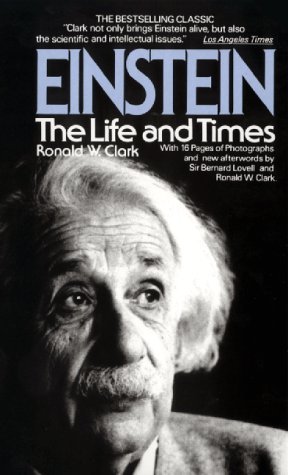
title: "Einstein: The Life and Times" main-author: "Ronald William Clark" tags:
- #book
 goodreads, wiki, amazon
openarchive, gutenberg
authors:
- Ronald William Clark
pdf links:
- https://spjnewswire.jrn.columbia.edu/access?digit=N37g604&FilesData=EinsteinTheLifeAndTimesRonaldWilliam_Clark.pdf
- https://climber.uml.edu.ni/HomePages/libweb/4040171/EinsteinHisLifeAndTimes.pdf
- https://conocer.cide.edu/HomePages/Resources/4000032/EinsteinTheLifeAndTimesRonaldWilliamClark.pdf
- https://conocer.cide.edu/index.jsp/Resources/4000032/EinsteinTheLifeAndTimesRonaldWilliamClark.pdf
- https://filemaker.journalism.cuny.edu/indexhtmfiles/browse/pdf/einsteinthelifeandtimesronaldwilliam_clark.pdf
- https://www.nasonline.org/wp-content/uploads/2024/06/einstein-albert.pdf
goodreads, wiki, amazon
openarchive, gutenberg
authors:
- Ronald William Clark
pdf links:
- https://spjnewswire.jrn.columbia.edu/access?digit=N37g604&FilesData=EinsteinTheLifeAndTimesRonaldWilliam_Clark.pdf
- https://climber.uml.edu.ni/HomePages/libweb/4040171/EinsteinHisLifeAndTimes.pdf
- https://conocer.cide.edu/HomePages/Resources/4000032/EinsteinTheLifeAndTimesRonaldWilliamClark.pdf
- https://conocer.cide.edu/index.jsp/Resources/4000032/EinsteinTheLifeAndTimesRonaldWilliamClark.pdf
- https://filemaker.journalism.cuny.edu/indexhtmfiles/browse/pdf/einsteinthelifeandtimesronaldwilliam_clark.pdf
- https://www.nasonline.org/wp-content/uploads/2024/06/einstein-albert.pdf
Short Description
"Delve into 'Einstein: The Life and Times,' a precise, no-nonsense exploration of the legendary physicist's journey. Cut through the myth and discover the man who reshaped our understanding of reality."
Goodreads Description
THE DEFINITIVE BIOGRAPHYAlbert Einstein was far more than the physicist who confidently claimed that space and time were not what they seemed to be. Middle age saw the man who described himself as "pas très Juif" blossoming out as a standard-bearer for Zionism. He passionately indulged in pacifism, and as passionately rejected it when Hitler began to show, unbelievably to most reasonable men, that he really meant what he said about the Jews and the master race. Throughout it all, Einstein stuck to the job at hand, as determined to squeeze the next fact out of Nature as a businessman intent on turning millions into billions.Ronald W. Clark has drawn an extraordinarily moving portrait of a man who was one of the great tragic figures of our time. It is the picture of a man who while still young abandoned much of life with the passion of the convinced monastic, and who was thrust back into it by the unobliging pressures of history. And in science the greatest physicist of three centuries, or possibly of them all, found himself after middle age pushed by the advance of quantum mechanics into a backwater, "a genuine old museum-piece," as he himself wrote.The life of Albert Einstein has been brought into brilliant focus by Ronald W. Clark's deeply significant and compassionate biography. Mr. Clark has drawn on a immense amount of new material. But he has never lost sight of the man who was one of the greatest contradictions of out times: the German who hated the Germans; the pacifist who changed his mind; the ambivalent Zionist who was asked to head the Israeli state; the physicist who believed in God."A fascinating description of the career and substance of a genius." -- Christian Science Monitor"A nonscientific reader will gain a real and imaginative impression of Einsteinian physicsA remarkable feat. Read the book. It is well worth it." -- C.P. Snow, Life"An adventure of the intellect, challenging and absorbing." -- Vancouver Sun"Applauded for its precision as well as its perception." -- Chicago Tribune"Clark not only brings Einstein alive, but also the scientific and intellectual issues." -- Los Angeles Times"Encyclopedic! Vivid and readable." -- New York Times Book Review
AI Summary
"Einstein: The Life and Times" by Ronald W. Clark is a comprehensive biography that details the life of one of the most renowned scientists of the 20th century, Albert Einstein. Below is a summary of the book, highlighting key ideas and topics:
Introduction
- Explores Einstein's legacy as a physicist and cultural icon.
- Highlights how Einstein's life and work transformed the perception of scientists.
Early Life
- Born in Ulm, Germany, in 1879, and raised in Munich.
- Struggled with traditional education but excelled in mathematics and physics.
- Influenced profoundly by his inquisitive nature and discussions with family friend Max Talmud.
Academic Challenges and Breakthroughs
- Faced initial difficulties in academia, including being rejected by the Polytechnic in Zurich.
- Eventually enrolled and graduated, finding a job at the Swiss Patent Office.
- Developed key ideas during this time, including the Special Theory of Relativity (1905).
The Annus Mirabilis (Miracle Year) Papers
- Published four groundbreaking papers in 1905.
- Special Theory of Relativity: Redefined the concepts of space and time.
- Photoelectric Effect: Demonstrated light's particle nature, contributing to quantum theory.
- Brownian Motion: Provided evidence for the existence of atoms.
- Mass-Energy Equivalence: Introduced the famous equation E=mc².
Scientific Fame and Personal Struggles
- Gained international fame, receiving the Nobel Prize in Physics in 1921.
- Balancing public life and personal challenges, including turbulent relationships and family responsibilities.
Later Scientific Work
- Developed the General Theory of Relativity (1915), providing new understanding of gravity.
- Engaged in efforts to unify physics through a unified field theory.
Social and Political Engagement
- Vocal advocate for pacifism and Zionism.
- Responded to rising Nazism and fled Germany for the United States in 1933.
- Contributed to World War II efforts, later advocating for peace and international cooperation.
Legacy and Impact
- Einstein's ideas revolutionized physics, breaking new ground in understanding the universe.
- Left a lasting impact on both the scientific community and popular culture.
- Remained a symbol of intellectual pursuit and humanitarian ideals.
Conclusion
- Clark presents a detailed narrative of Einstein as both a brilliant scientist and a complex individual.
- The book offers insights into the challenges and triumphs that shaped Einstein's life.
This summary encompasses the essence of the book and provides a concise understanding of Albert Einstein's journey, achievements, and the profound impact he made on the world.
Bertrand Russell Summary
"Einstein: The Life and Times" stands as a formidable exploration into the life of perhaps the most revolutionary figure in the annals of modern physics, Albert Einstein. Through the weave of its narrative, the book illuminates not only the mind behind the theory of relativity but the human enshrined within his complex existence, embodying both the personal and the philosophical.
To grasp the magnitude of Einstein's contributions is to delve into an epochal transformation of human thought, one which traverses the boundaries between the tangible and the metaphysical. The book reveals an extraordinary confluence of genius and simplicity, a man who perceived the universe in its elegant intricacies yet approached it with an insatiable curiosity intrinsically childlike in its innocence.
The essence of Einstein's intellectual legacy, rooted in the renegotiation of space and time, reflects a broader philosophical dissent against the dogmas that stifled early 20th-century science. It is here we witness the interface of science and philosophy, a conjunction fraught with profound implications, not merely for physics but for the edifice upon which our understanding of reality is constructed. Einstein's theories undermined the Newtonian mechanics that governed scientific certainty for centuries, embodying a spirit of skepticism becoming to Russell himself.
Beyond his scientific pursuits, the book unearths Einstein's deep humanism, portrayed vividly through his advocacy for peace, civil liberties, and a deep-seated mistrust of authoritarianism. Here was a man for whom thought and action were inextricably linked, whose reflections on the universe were paralleled by a commitment to societal progress, echoing the philosophical purport that a life dedicated to thought ought also to bear moral responsibility.
Yet amidst the grandeur of intellect, the narrative does not shy away from the contradictions inherent to his personal life—Einstein the pacifist juxtaposed with the man who endorsed the letter to Roosevelt urging nuclear armament, Einstein the aloof father, the complex nature of his relationships, and his moments of self-doubt. Such contradictions render him not less but more human, a testament to the multifaceted nature of intellectual giants.
In sum, "Einstein: The Life and Times" presents a rich tapestry of a life lived at the confluence of science, philosophy, and humanity. To traverse its pages is to engage with a dialogue between profound scientific discovery and enduring philosophical inquiry, a narrative that, much like Einstein's own work, invites endless reflection and critical engagement.
Notes
Original Content
- https://www.goodreads.com/book/show/1182114.Einstein
- wiki
- amazon
- openarchive
- gutenberg
- Ronald William Clark
- https://spjnewswire.jrn.columbia.edu/access?digit=N37g604&FilesData=EinsteinTheLifeAndTimesRonaldWilliam_Clark.pdf
- https://climber.uml.edu.ni/HomePages/libweb/4040171/EinsteinHisLifeAndTimes.pdf
- https://conocer.cide.edu/HomePages/Resources/4000032/EinsteinTheLifeAndTimesRonaldWilliamClark.pdf
- https://conocer.cide.edu/index.jsp/Resources/4000032/EinsteinTheLifeAndTimesRonaldWilliamClark.pdf
- https://filemaker.journalism.cuny.edu/indexhtmfiles/browse/pdf/einsteinthelifeandtimesronaldwilliam_clark.pdf
- https://www.nasonline.org/wp-content/uploads/2024/06/einstein-albert.pdf